
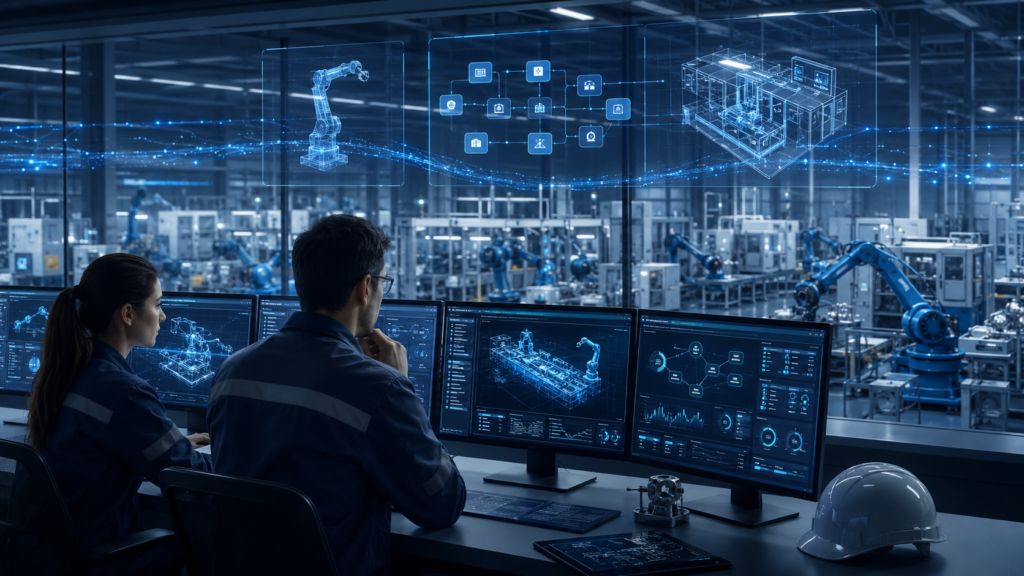
Industrial AI is entering a more practical phase. The conversation is no longer only about whether AI can generate insights, write code, or answer questions. For manufacturers, the more difficult question is whether AI can work inside real engineering, production, maintenance, quality, and service environments.
That is where Siemens’ new Intelligence Center X becomes relevant. Announced by Siemens Digital Industries Software, Intelligence Center X is designed to help companies orchestrate industrial AI across connected workflows, human teams, AI agents, and lifecycle data.
In simpler words, Siemens is not only offering another AI feature. It is trying to solve one of the harder problems in industrial AI: how to make AI useful inside complex industrial operations where decisions depend on machines, products, processes, engineering history, compliance rules, and human expertise.
What Siemens has announced
According to Siemens, Intelligence Center X is built to support the next phase of industrial AI by bringing together people, AI agents, and industrial data. The platform is designed to help users create, deploy, manage, and monitor AI-enabled workflows across industrial environments.
The announcement fits into Siemens’ larger Xcelerator strategy, which focuses on digital transformation across industry through software, automation, digital twins, and open ecosystem-based platforms.
For manufacturers that already use systems such as PLM, MES, ERP, simulation tools, automation platforms, and digital twins, the real value of AI will depend on how well these systems can work together. A factory does not become intelligent only because an AI tool is added on top. It becomes smarter when AI has access to the right operational context and can support real decisions.
This is the gap Intelligence Center X appears to be targeting.
Why manufacturers are looking beyond AI pilots
Many industrial companies have already experimented with AI. Some have used it for predictive maintenance. Others have tested it for production planning, machine vision, quality inspection, customer service, documentation, design support, or internal knowledge search.
However, moving from pilot projects to daily production use remains difficult.
One reason is that industrial environments are highly contextual. A model may detect a pattern, but the decision still depends on machine condition, part history, material variation, operator experience, safety limits, design requirements, and production priorities. This is very different from using AI in a simple office workflow.
Another challenge is trust. Manufacturing teams cannot rely on an AI system if they cannot understand where the recommendation came from, which data it used, and whether it fits current operating constraints. For high-value production lines, regulated industries, and engineering-heavy businesses, AI must be traceable, governed, and connected to existing workflows.
This is why orchestration is becoming a major theme in industrial AI. Companies do not only need AI models. They need a way to manage how AI agents work, where they get data from, who approves their actions, and how their outputs fit into business processes.
Market context: AI adoption is high, but scaling remains difficult
The broader AI market shows the same pattern. AI usage is expanding quickly, but scaling remains uneven.
McKinsey’s 2025 State of AI report found that AI adoption has increased across organizations, but many companies are still working out how to scale AI in a way that changes workflows and creates measurable enterprise value. The report also notes that many organizations are experimenting with AI agents, but scaling them across business functions remains limited.
For industrial companies, this is a familiar problem. A successful AI demo may look impressive, but the real test is whether the system can be used repeatedly by engineers, operators, planners, service teams, and managers without creating new risks or confusion.
This is also why industrial AI platforms are likely to become more important. Manufacturers will need tools that can connect AI with domain-specific data, workflow governance, human review, cybersecurity, and operational systems.
Where Intelligence Center X fits in the industrial AI trend
Intelligence Center X reflects a shift from single-use AI tools toward connected AI environments.
In the first phase of AI adoption, many companies focused on experimentation. They tested chatbots, copilots, analytics dashboards, and automation tools. In the next phase, industrial companies will need AI systems that can support full workflows.
For example:
- An engineering team may need AI to identify design risks, compare part revisions, and suggest documentation updates.
- A production team may need AI to detect quality issues and recommend process adjustments.
- A maintenance team may need AI to connect sensor data with service history and failure patterns.
- A manager may need AI to summarize operational performance and highlight bottlenecks across sites.
These use cases require more than a standalone AI model. They require integration with industrial systems and clear rules for how AI outputs are reviewed and acted upon.
By focusing on AI orchestration, Siemens is addressing the layer between AI capability and industrial execution. That layer may become one of the most important parts of enterprise AI adoption in manufacturing.
IndustryR view
Siemens’ Intelligence Center X is important because it points to the next stage of industrial AI: controlled deployment inside real operating environments.
The strongest industrial AI platforms will not be judged only by how advanced their models are. They will be judged by how well they connect with engineering data, factory systems, compliance requirements, human expertise, and business workflows.
For manufacturers, the lesson is clear. AI value will not come from adding disconnected tools everywhere. It will come from building the right foundation for AI to work with trusted data, clear governance, and practical workflows.
In that sense, Intelligence Center X is part of a larger movement in manufacturing technology. Industrial AI is becoming less about experimentation and more about execution.
Sources
Siemens official announcement:
https://news.siemens.com/en-us/siemens-intelligence-center-x/
McKinsey State of AI 2025:
https://www.mckinsey.com/capabilities/quantumblack/our-insights/the-state-of-ai
Editorial note: This article is based on publicly available company announcements and industry sources. IndustryR has added independent context, market data, and editorial analysis for reader value.